In 2020 my friend, Dottie, posted on Facebook a post card depicting the Eastern Maine Insane Asylum soon after the complex of buildings was completed in 1901. Also called the Eastern Maine Insane Hospital, the utter scale of the institution was astonishing. In 1913 it was renamed the Bangor State Hospital and as late as 2005 it was still called the Bangor Mental Health Institute. Now called the Dorothea Dix Psychiatric Center, some of these buildings still serve an institutional purpose in 2024, housing — you guessed it, people who have been committed short-term and long-term for mental illness.
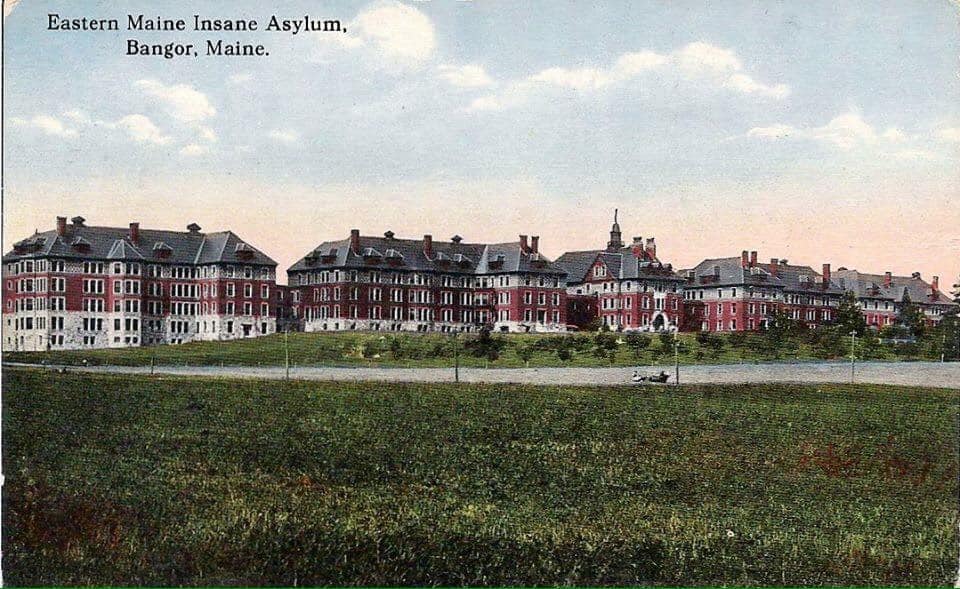
Dorothea Dix has a capacity of 80 patients and in mid-2024 the population is around 60.

The point of this is not to discuss BMHI, as many of us still refer to it. My friend’s posting of the post card reminded me of a set of files I had saved from a long-ago internet search.
Offered here are the Orleans Parish Civil Sheriff Register of patients transported to the (Louisiana) State Insane Asylum, year by year, from 1882 to 1908 (minus three years). This was the same period that saw the transition from the Maine Insane Hospital in Augusta to the establishment of what is depicted in the post card.
The Orleans Parish records list “patients” by name, but what is hugely sobering are the reasons given for admitting them to the insane asylum. And what must have become of their belongings, their property not brought with them, their children and spouses, their lives? Their freedom?
Reasons given for admission included stupidity, hallucination, religious mania, raving madness, epilepsy, congenital imbecility, kick by mule, and my favorite: softening of the brain. But the lists below reveal so much more concerning suppositions of insanity in those years.
As a result of the social upheaval during the 1960s, people are no longer committed “on the say-so of two or more sane citizens.” Whether for good or ill, our culture has codified the right of an individual to be a nuisance, a public menace, a vagabond, a freeloader. Anyone who at least refrains from committing a crime (and even most anyone who does commit a succession of crimes) is free to behave in any way that doesn’t result in private retribution or self-caused death.
Incidentally, for my own perspective on the time line of these records, my maternal grandparents were born in 1882 and 1884, so these Louisiana records come from the period when they was growing up in Ohio and starting a family. And as a second thought, my father worked for a period in the 1950s or 1960s, when I was a child, at the Lima State Hospital for the Criminally Insane in Lima, Ohio. I don’t recall that he brought any stories home from the place, but I do recall that the experience affected him, perhaps to keep him on the straight and narrow.
The following files are the lists that I saved during that internet search. They speak for themselves and are probably comparable to the records of any other state, if those records have been kept.
 DamnYankee Publishing