The story in Fire, Wind & Yesterday takes place between A.D. 842-863, culminating precisely when an event of profound historical significance was taking place just to the east of what is now Ukraine. The event consisted of a series of meetings now known as the Khazar polemic. At these meetings, at the invitation of the Khazar ruler — the khagan, representatives from the world’s three significant monotheistic religions convened to persuade the khagan to convert himself and his people to Judaism, Christianity, or Islam.
While representatives of the Orthodox Church in Greece were on their journey to make their case for Christianity, others of the Church were exploring more deeply into the forest and steppe north of the Black Sea. It was the mission of these venturers to bring back information about the extent of the Khazar influence, the region’s people, and how the Church might properly reach farther into these lands.
It is a party of these explorers who inhabit Fire, Wind & Yesterday as well as those whom they encountered and what they learned on their journey.
author’s perspective
As many do, I met God when I was a teenager. It was in learning of the crucifixion of Jesus that I first grasped the human capacity for hatred and for cruelty. And I came to appreciate, in time, the human capacity for suffering, for endurance, and for forgiveness. Eventually I married, and children came into our lives. As succeeding decades have come and gone we have continued to live in tenuous rural security and modest prosperity. As a young family we adopted a church and were adopted by it. Through its liturgy and lectionary I delved more and more deeply into the roots of Christianity.
Communism aside, Russia fascinated me through my childhood — its culture, its history, its seeming remoteness — a riddle wrapped in a mystery inside an enigma, as Winston Churchill so aptly described it. In college I began my immersion into the Russian language, but also, through a Russian professor, I began learning how the Orthodox Church figured in.
grace, blessings, miracle number one
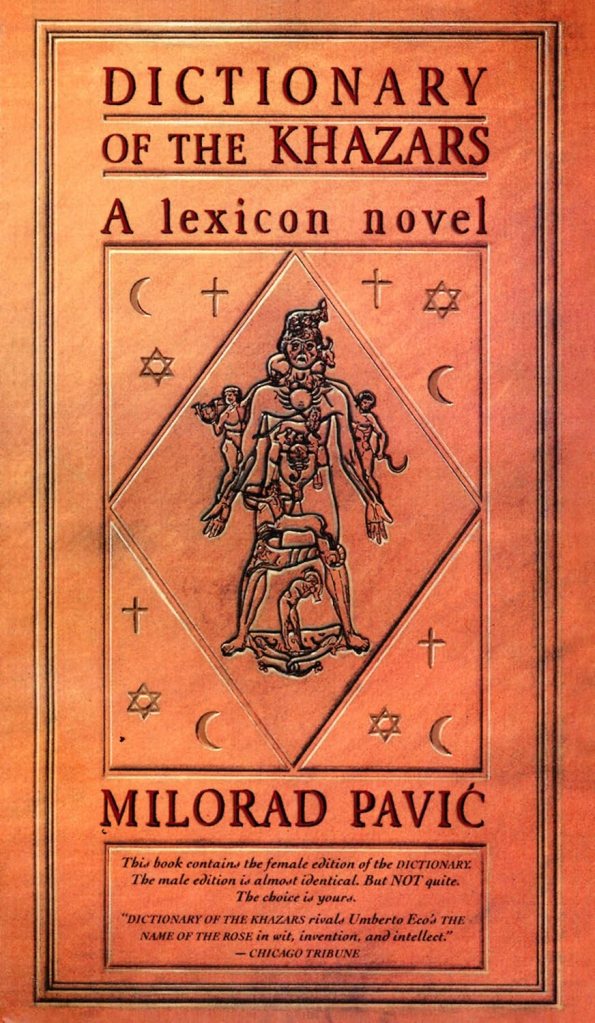
I was in my late thirties when I began writing Fire, Wind & Yesterday in 1989. I was unprepared for the instances of divine intervention that would propel me through the creation of the novel. Two examples stand out. There is precious little recorded history of the Khazar Polemic, and the Khazar khaganate disappeared from civilization within a few centuries of the Khazar Polemic’s occurrence. As I was writing, in the wilderness of northern Maine and in the years just before there was an internet, I had only Millinocket’s small-town library for research. While I had a few resources at home as well, I did learn of one book that might give me another author’s perspective and perhaps, even, some historical background. The book was Dictionary of the Khazars, an imaginative novel by Milorad Pavić, published thirty years before I had begun my story.
I could not afford to assert something in writing about the Khazars that would conflict with the works of others, such as Pavić and other reliable historians, so I asked my local library to obtain a copy of the book through inter-library loan. It was not a surprise that they located one at Norwich University. Norwich had a thriving Russian studies program at the time and perhaps still does. But what I obtained through inter-library loan were a few pages photocopied from some random chapter in Dictionary of the Khazars.
I didn’t dare proceed with my story without some way to verify many of my assumptions — assumptions about travel 1100 years ago, about food, displaced or nomadic people, geography, flora and fauna, and more. And there was more to consider. What about the Khazar people themselves? It’s not that these uncertainties would be answered in that one book. But it could not fail to help.ail to help.
Disappointed in the teaser of a few copied pages that I had been offered, I felt I had hit a barrier. It wasn’t writer’s block really. Perhaps a divine warning not to waste further time on it? I had a full-time executive career in a Fortune 500 company and in 1990 our son, Sam, was born with multiple physical and developmental problems. That same summer our daughter, Ruth, who had already endured one knee surgery at 12, was run over by a car and needed surgery on the other knee. The book I was writing was about half finished, and it had to be laid aside.
In early 1991, after things quieted down a little, I strolled into our one local bookstore, Mr. Paperback, and began perusing the disorderly array of books, hundreds of titles at discount prices, spread across a long line of tables in the middle of the store. Toward the far end one paperback cover in bright, coppery-orange, stood out. There it lay, just one copy: Dictionary of the Khazars. Not only was it the real thing but the price was right.
I devoured the book, which at least reassured me that my story was strong and the settings were authentic. I brought my novel to a satisfactory close in late 1995, and in early 1996 I was trolling cover letters and sample chapters before literary agents. None deigned to request the manuscript nor even asked for more chapters. I had a friend, though, who ran a small printing business in town, producing business cards and menus for restaurants and such, and he offered to convert my typewritten pages into a comb-bound 6-by-9 volume. If I couldn’t get it in front of publishers, he reasoned, I could at least pay him to print a couple book-sized copies for myself. And so we did that.
Some may contend that finding an obscure book just when I needed it was not a miracle, nor what happened next. To me each is miraculous, and that those two things, as well as other developments that took place before and afterward, happened in close and perfect sequence, places them far beyond even cosmic coincidence.
miracle number two
In the spring of 1996 Ruth was attending Husson College in Bangor. She came home for a visit one weekend in March and said: “Dad, you have to meet my friend, Aika. She’s Georgian, from Tbilisi, and you could talk to her in Russian.” I thought there would be little chance of meeting the girl, knowing how college life works. But that same Sunday, when we drove Ruth back to Husson from Millinocket, we stopped first at Border’s Book Store in Bangor. As we were all walking through the two sets of double doors at the store’s entrance amid the flow of customers coming and going Ruth squealed: “Dad, it’s Aika!” Sure enough we had intercepted the girl just as she was leaving the store.
Aika and I conversed in Russian for a minute, and then a woman behind her said to me: “You speak Russian very well. You should come to Russia with us.” I could only wonder who the heck she was and what she might have to do with our spontaneous encounter. Then she explained. The woman’s husband was Georgian, and they were Aika’s sponsor in the United States while she was here in college. The group she was inviting me to join for a trip to Russia was the Surry Opera Company. This was a group of singers who gathered in the town of Surry, on the coast of Maine, to practice and perform songs from classic operas — not a full opera itself with costumes and sets, only the music. For some years this group had been making annual trips to St. Petersburg. They would stay for two weeks, practice their songs along with similar amateur groups from other countries, and put on a performance at the end of the period before returning home.
In subsequent discussions with her I was offered the opportunity to append myself to the group, not as a singer though. Once there, she explained, I would be free to wander the country for two weeks but would need to make sure I was back in St. Petersburg for the return flight with the group. I would enjoy the group rate for airfare and related transportation, stay with local people for the few nights I might want to spend in the host city, and enjoy the same manner of sponsorship in Russia as the singers.
I accepted the offer, and in August of 1996 I landed first in Russia but soon afterward made my way to Ukraine. I spent a few days on the banks of the Dnepr (Dnieper), inside the Kievo-Pecherska Lavra (the Kiev Monestary), in the countryside in both directions beyond the river, exploring the settings of my story with an author’s proof of Fire, Wind & Yesterday in my backpack.

No one there cared about my book, of course. It was important only to me… but perhaps it was also important to God. For I cannot imagine how that sequence of events could have unfolded with such perfect timing unless there was a divine hand in their occurrence. What’s more, these two wondrous events happened soon after two other necessary developments: I had a twenty-year restriction on travel to the Soviet Union after my discharge from military service in 1973, due to my role as a Russian-language translator and cryptanalyst under the NSA. And if the Soviet Union had not collapsed in 1992, about the time when I was resuming my writing after obtaining the Pavić book, I would not have been free to meander through those countries unrestrained. And such a trip could not have happened much later than that for, once Vladimir Vladimirovich Putin appointed himself Tsar Vladimir the Terrible in 2000, and once we were attacked on September 11, 2001, I would no longer have dreamed of making a solo trip through Russia and Ukraine.
So there it is, apart from useless details. This book was a driven by a need to write a meaningful story, by a fascination with the scriptures and the early Christian writers, and by a longing to do something useful for God. I have felt that it is I to whom Jesus referred when he said: “From him to whom much is given, much will be expected.”
 DamnYankee Publishing